
The Art That Began Everything — The Mysore Rosewood Inlay Oval Plaque
Before the framed wall art. Before the city monuments series. Before the 3D wooden sculptures. There was this — the oval rosewood plaque. The original. The art form that put Mysore on the handicraft map of India and the world. The craft that gained prevalence during the reign of Tipu Sultan in the 18th century and was later encouraged by the Mysore Maharaja from the Wadiyar Dynasty into one of India’s most celebrated and distinctive art traditions.
This GI-tagged Mysore Rosewood Inlay Oval Plaque from Anitha Fine Arts is not a reproduction of a heritage art form. It is the heritage art form — alive, practiced, and as extraordinary today as it was when the artisans of Mandi Mohalla first began working this wood in the shadow of the Mysore Palace.
The Material — Solid Indian Rosewood
Mysore inlay paintings carry out the art using a fine-grained wood type such as rosewood as the base for the painting. This plaque is carved from a single solid piece of Indian rosewood — one of the most prized hardwoods in the world, known for its extraordinary grain density, its rich natural colour range, and the warm, deep lustre it develops with age and polish.
Look at the plaque and you will see what solid rosewood truly looks like: the grain flows in sweeping curves of amber, warm burgundy, deep chocolate brown, and rich auburn — no two pieces of rosewood ever repeat the same grain pattern. The surface is convex — slightly domed outward — giving the plaque a natural three-dimensionality and weight that flat panels cannot replicate. It catches light from every angle differently. In morning light it glows amber. In evening light it deepens to almost burgundy. This is a living material — and it will continue to deepen and enrich with age over decades of display.
The Art — The Mysore Inlay Tradition
Mysore Inlay art is a traditional art form where intricate designs are created using embedded pieces of bone, ivory, or other materials on a wooden surface — a process that involves carving a design on a wooden base using sharp tools and filling the hollow part with new materials, such as different-coloured wood, brass, gold, silver, or even resin.
The raw materials used include a fusion of rosewood, yellowwood, ebony, pathangadamara, and colourful acrylic sheets — while ivory was traditionally used, modern ethical practices have shifted to plastic and acrylic alternatives that achieve the same visual effect without environmental harm.
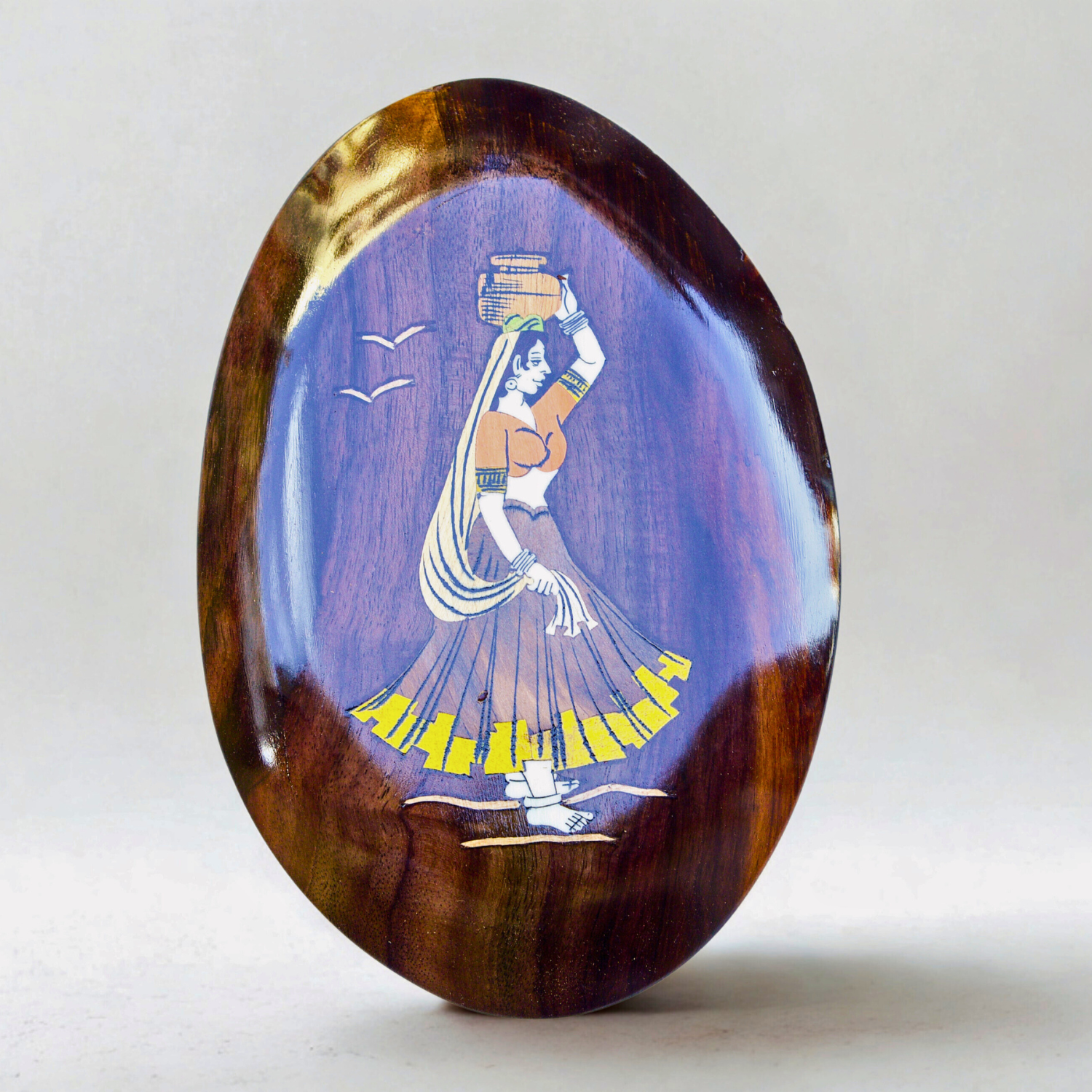
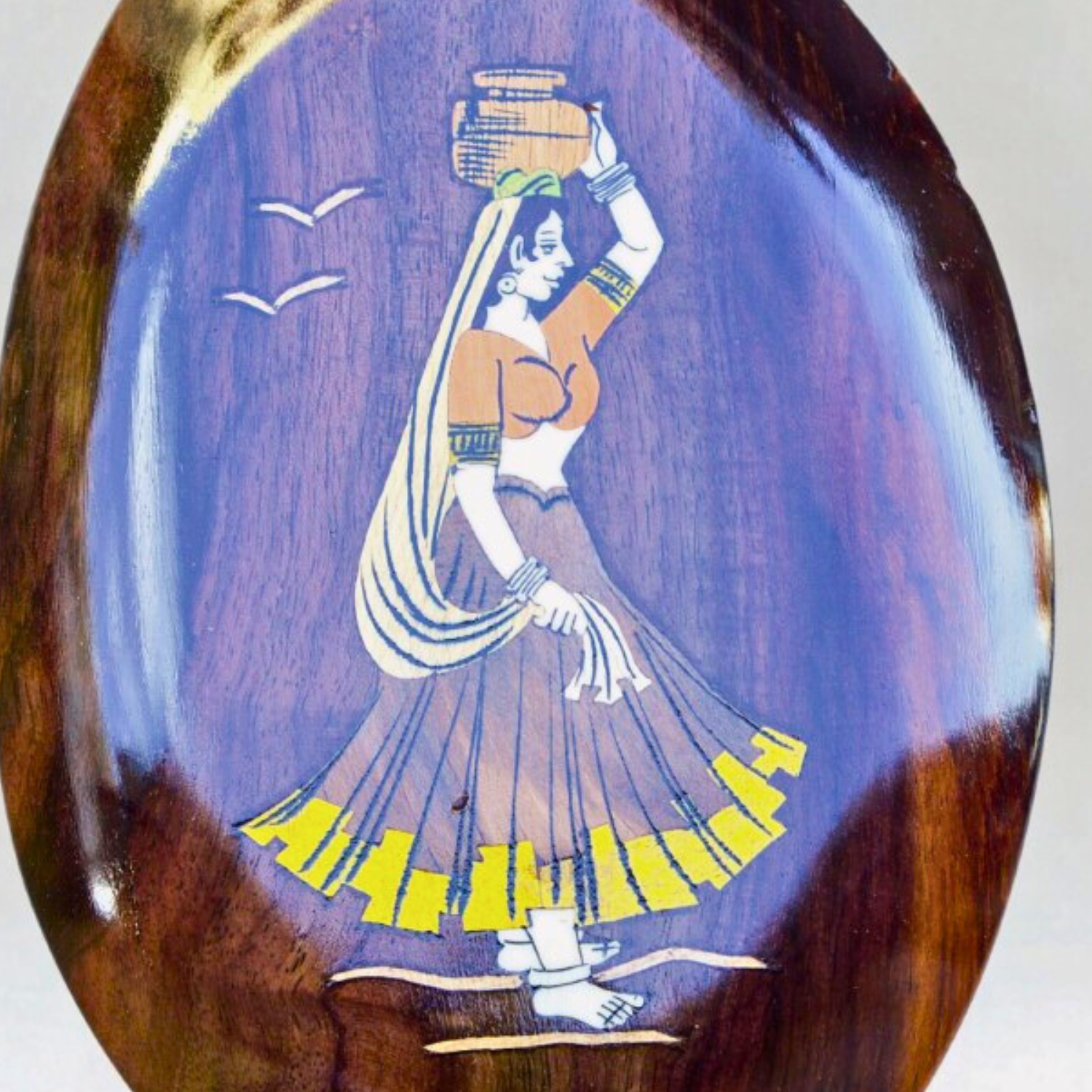
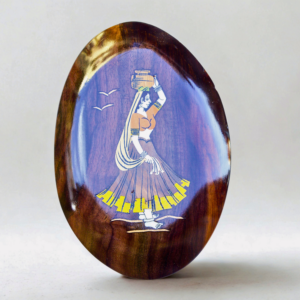
The subject of this plaque is one of the most beloved in the Mysore inlay tradition — a traditional South Indian woman carrying a pot with birds above her — a scene of rural grace that has been painted and inlaid by Mysore artisans for generations. Here she is rendered with extraordinary detail:
Her posture — the slight forward lean of someone carrying weight gracefully, the turn of the neck, the elegant extension of the supporting arm — captures the biomechanics of the water-carrier with the observation of an artist who has seen this scene many times and understands it deeply.
Her ghagra sweeps in long flowing lines from waist to ankle — the pleated skirt rendered in fine inlaid lines, with a vivid yellow geometric border trim at the hem that brings warmth and celebration to the composition. The yellow of that border — the yellow of turmeric, of marigolds, of festival — is one of the most culturally loaded colours in Indian visual tradition.
Her adornments — the green headscarf, the multiple bangles on both wrists, the ankle ornaments, the simple earring — are the details that place her precisely in the rural Indian tradition. Each ornament is individually inlaid with coloured material.
The matka balanced on her head — the traditional unglazed clay water pot — is rendered with the same woven-texture detail that appears on real handmade pottery, right down to the decorative banding near the mouth.
Above her, two birds in flight — rendered in simple white strokes against the lavender-blue ground — complete the scene with a sense of open sky, freedom, and the perpetual Indian relationship between the human figure and the natural world.
All of this is painted and inlaid on a deep lavender-blue ground that is applied to the recessed centre of the oval — a colour that simultaneously suggests sky, water, and the timeless quality of memory. Against this blue, every warm tone of the figure — the ochre skin, the ivory garments, the yellow border, the warm matka — glows with extraordinary richness.
In the final step, the painting is given a glossy finish by applying beeswax onto the surface, giving the rosewood its characteristic deep, warm lustre and protecting the inlay work for generations.
Display Options — Wall and Freestanding
Unlike the framed wall art pieces in the Anitha Fine Arts range, this oval plaque is a freestanding object as well as a wall-hanging piece. It can be:
- Hung on a wall using the hanging provision on the reverse — displaying the full oval against any wall surface
- Stood upright on a shelf, mantelpiece, console table, or bookcase — where the natural base of the oval allows it to rest without support
- Displayed on a plate stand or picture easel for a gallery-style presentation
This versatility makes it the most flexible piece in the entire range — equally at home on a wall, a shelf, a desk, or a display cabinet.

Reviews
There are no reviews yet.